Tuesday, 3 September 2013

STORIES OF THE 17TH/18TH/19TH CENTURIES.


KILLED BY A CANNON BALL
 
 
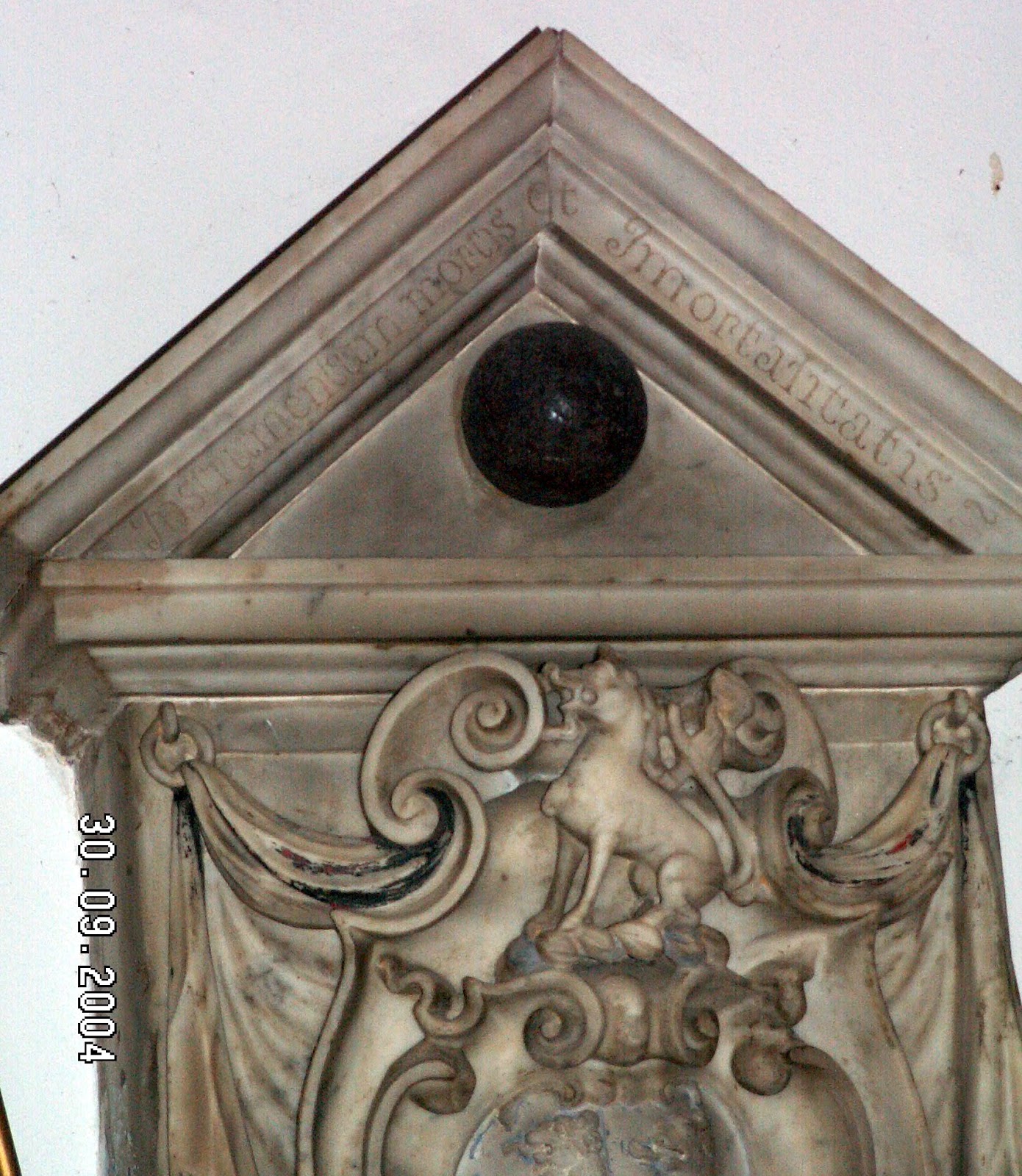
In 1664 General Richard Nicolls of Ampthill in Bedfordshire drove the Dutch out of New Amsterdam in the New World, renaming the town New York after his patron The Duke of York. 
He was killed eight years later in a naval battle and the cannon ball which caused his demise is preserved on his monument in the church at Ampthill.


A BRAVE DRAGOON
 
Early in the 18th century, young Tom Brown was a shoemaker in the small market town of Yarm in North Yorkshire.  He was a big strong man and he decided to join the army, serving in the Inniskillen Dragoon Guards.  Brown fought against the French at the Battle of Dettingen in 1743, part of the Austrian War of Succession,  at which George 11 was the last British King to lead his troops in battle.   Brown had already had two horses shot from beneath him and had also lost two fingers in the fighting, when the dragoon’s standard was captured.  Despite his injuries, Brown charged the enemy and shot the soldier holding the standard recovering the pennant.   He then fought his way back to his own lines as a shot grazed his head, whilst two further shots lodged in his back.  He also suffered a deep cut to his forehead and his nose was almost entirely cut away.
 Brown was a national hero and was presented with a gold headed walking stick and a silver cap to cover his damaged nose by the King himself.  He then served briefly in the Lifeguards but was invalided out with a pension of £30.   Brown returned to Yarm and ran The Tom Brown Inn in the High Street until his premature death three years later.   He was buried in an unmarked grave in Yarm churchyard.
 The only reminders of this brave man are a portrait in Preston Park Museum and a plaque on the former inn, now a house, in Yarm High Street.     The cottage where Brown was born at Kirkleatham near Redcar is long gone but an oak tree still occupies the site outside the almshouses there.  It is thought that Brown’s father, who was the village blacksmith, planted the tree to commemorate his son’s bravery.


The former Tom Brown Inn at Yarm


A SUCCESSFUL DOUBLE


Roderick MacKenzie was not only a supporter of Bonnie Prince Charlie at the Battle of Culloden in 1746,  but he was also strikingly similar in appearance to the Prince.  So much so that after the battle was lost, MacKenzie was used as a double to deceive the British troops into thinking that they had in fact found the Prince who had made good his escape over the sea to Skye.  MacKenzie was killed in Glen Moriston not far from Loch Ness where a cairn marks the spot and bears a commemorative plaque. 
The cairn is situated alongside the southern side of the A887 just 2 miles east of its junction with the A87.


The cairn is situated alongside the southern side of the A887 just 2 miles east of
its junction with the A87.


TOO MUCH SMALL BEER


A gravestone in the graveyard at Winchester Cathedral records the unusual death of a soldier :

‘ In memory of THOMAS THETCHER,

A Grenadier in the North Regt. Of  Hants. Militia,
Who died of a violent Fever contracted by drinking Small beer when hot
 the 12th of May 1764, Aged 26 years.
In grateful remembrance of whole univerfal good will towards his comrades,
This stone is placed here at their expence, as a fmall teftimony
of their regard and concern.
Here fleeps in peace a Hampfhire Grenadier
Who caught his death by drinking fmall Beer.
Soldiers be wise from his untimely fall
And when ye’re hot drink Strong or none at all.’
This memorial being decay’d was reftor’d by the Officers and the Garrifon A.D 1781.
An  honeft Soldier never is forgot
Whether he die by Mufket or by Pot.
The stone was replaced in 1802 and again in 1966.


V.C REMEMBERED


A simple grave stone marks the last resting place of Private John Divine  V.C in the Roman Catholic section of Penzance Cemetery in Cornwall.    Irish born Pte Divine fought all over the British Empire
and won the Victoria Cross in Delhi on 10th September 1857 during the Indian Mutiny, when he led a charge on a gun emplacement and lost his right leg.  He was invalided out of the 60th Rifles after receiving his V.C from Queen Victoria herself.
Divine settled in Penzance where he was a familiar figure  touring the town selling fish, with his wooden leg propped up on the seat of his donkey cart , on which he proudly displayed his V.C.    He died in 1888 and was buried in a paupers grave.  In 1995, 107 years later, Field Marshall Lord Brammall, former Chief of the Defence Staff, unveiled a new headstone provided by Devine’s regimental association in memory of a brave soldier.


The Atholl Highlanders

The Atholl Highlanders is a private infantry regiment in the employ of The Duke of Atholl based at Blair Atholl Castle. It is the only legal private army in Europe. It was formed in 1839 by the 6th Duke as a body guard and escorted Queen Victoria on her tour of Perthshire in 1842, following which the Queen granted the regiment with colours giving it official status. Although the regiment has never seen active service, many of its numbers served in the two World Wars.

The Atholl Highlanders are now purely ceremonial and its 100 men, including pipes and drums, wear the Clan Murray tartan. The regiment’s officers are usually lairds from the surrounding area whilst the other ranks are mainly employed on the Atholl Estate. They parade at the Atholl Gathering at the end of May when they are inspected by the present Duke; and also march to the Braemar Games in September. The Duke also permits the regiment to parade on certain other occasions such as Royal visits and overseas tours.


Monday, 2 September 2013

THE ENGLISH CIVIL WAR


AN ACT OF WAR


The preserved foundations of Beverley Gate in the heart of the bustling shopping centre at Hull in East Yorkshire bear a plaque which testifies to the first overt act of The Civil War on St. George’s Day in 1642.

A panel in the so called Plotting Room at Ye Olde White Harte pub in Silver Street tells of the events of 23rd April, 1642  :
 
 ‘Whilst Sir John Hotham, the Governor of Hull, was giving a dinner party he received an intimation from the King that His Majesty, who was then only four miles from the town, deigned to dine with him that day. The Governor, filled with surprise at the unexpected news, retired to his private room (since called The Plotting Room) and sent for Alderman Pelham, the M.P for the Borough. It was then resolved to close the gates against the King and his followers and a message was dispatched to his Majesty informing him of the decision.The soldiers were called to arms, the bridge drawn up, the gates closed and the inhabitants confined to their houses.About 11 o’clock the King appeared at Beverley Gate but the Governor refused to allow him to enter the walls.  The King then called upon the Mayor but that official fell upon his knees and swore that he could not assist as the gates were guarded by soldiers.  Whereupon the King, after much strong discussion and proclaiming Hotham
a traitor, withdrew to Beverley.’


Ye Olde White Heart


The Plotting Parlour


THE LEVELLER'S


A poignant signature scratched on the lead lining of the font in Burford Parish Church recalls an incident of mutiny within Cromwell’s New Model Army.  It reads :

‘ANTHONY SEDLEY

1649. PRISNER’


He was one of the supporters of 'The Levellers', a group of radicals who were crushed by Cromwell.   On May Day 1649 the army had reached Salisbury on its way to Ireland when eight soldiers refused to go any further until their complaints were satisfied.  They wanted a levelling of the ranks within the army and an end to Cromwell’s campaign in Ireland, as well as the considerable back pay owed to them.  Several hundred troops ended up deserting, eventually meeting up with more comrades in Banbury.  The upshot was that they were defeated by loyal troops and imprisoned in Burford Church, the only building in the area big enough to contain them.  Three of their leaders were court martialled on the spot and sentenced to death.  On the morning of 17th May the majority were taken up onto the church roof so that they could watch whilst Cornet Thompson, Corporal Church and Private Perkins were put against the church wall and shot.


Burford Church


ROYALIST SURVIVOR'S
 
 
In 1664, Royalist Sir William Ingilby of Ripley Castle had raised a troop of horsemen from the Ripley district and had joined the King’s army in the battle. Sir William was also accompanied by his sister who was known as 'Trooper Jane' and disguised as a man she wore a full suit of armour. The Ingilby’s had managed to escape back to Ripley and must have been most alarmed when Cromwell arrived at their gate demanding admission. Jane quickly hid her brother in a secret priest’s hideaway in the castle and then admitted Cromwell who insisted on staying overnight in the castle. Jane granted his wish on the understanding that she would remain armed with two pistols and Cromwell was allowed to sleep in the castle library with Jane standing guard.


Ripley Castle 


Oliver Cromwell billeted his troops and stabled his horses in All Saints church at Ripley after the  battle. He had pursued the losing Royalist’s after the battle and reached Ripley by nightfall.


Ripley Church
 

Several Royalist prisoners were executed against the rear wall of the church where bullet marks are still evident today.


The bullet marks 


Before he left Ripley, Cromwell is said to have had a carved inscription added to the church memorial and tomb of a former Sir William Ingilby which can still be seen today. It reads:
 
‘NO POMPE, NOR PRIDE
LET GOD BE HONORED'
 
degenerating the rhyming inscription on the memorial praising Sir William.


Sir Richard Graham of Norton Conyers Hall near Ripon in North Yorkshire also fought for the King at the Civil War Battle of Marston Moor. Graham was wounded in the battle but his horse returned him safely home and even tried to take Sir Richard up the stairs to his bed chamber. A scorched hoof print is still visible on a landing at Norton Conyers.


WARS OF THE ROSES.


A WAR LORD


Ralph, Lord Dacre of Gisland, was one of the Lancastrian leaders at the Battle of Towton, a ‘Wars of the Roses’ battle fought on 29th March 1461, when the Lancastrians were routed and some 37,000 men were killed.   It is said that after this battle the River Wharfe ran with blood, and that a white wild rose, with a red blood-like splash of colour in the centre, still grows in the area; the colours representing those of the contestants.  Lord Dacre, it is said, was shot by an arrow which had been fired by a young boy from a tree, apparently in revenge of his father who had been killed by Lord Dacre.

His Lordship was buried in the churchyard of All Saints church at Saxton, a village on the edge of the battlefield.  Apparently He was buried sitting on his horse, a fact that was confirmed in 1861, when a horse’s skull and bones, together with  the skeleton of an upright man were found in the tomb.   The railed tomb is situated in the graveyard, on the north side of the church and bears the inscription :

‘ Here lies Ralph, Lord Dacre of Gisland,

A true soldier valiant in battle in the service of King Henry V1,

Who died on Palm Sunday, March 29th, 1461,

On whose soul may God have mercy.’


Lord Dacre's tomb

ODDITIES AND INTERESTING STORIES RELATING TO MILITARY MATTERS.


My interest in oddities now extends to military matters and a few interesting stories.


THE SWORDSMAN


One date in history which readily springs to mind is 1066, that momentous year which changed the face of our country.  Indeed it was a momentous year for Saxon King Harold – he who was supposedly shot by an arrow in the eye at the Battle of Hastings.  What is not so well remembered is
that Harold had marched his troops some 250 miles from Stamford Bridge near York after defeating the Norwegians there, to engage the Normans in his final battle.

The Swordsman Inn, situated alongside the bridge over the River Derwent at Stamford Bridge, reminds us of a heroic event which turned the battle of 1066 in Harold’s favour.   It was vital that Harold’s troops should cross the river but the only way across was by way of a narrow wooden bridge which was blocked by a huge Norwegian warrior who managed to slay all the soldiers who tried to dislodge him.   Apparently the day was saved by a brave young soldier who floated under the bridge in a tub and managed to stab the warrior through a gap in the wooden bridge.   Thus the way was clear and the victorious Saxon army stormed across.


Battle memorial 


Until 1878, a Spear Pie Festival was held annually in the village with the traditional pie being boat shaped and filled with pears.   The festival was temporarily revived in 1966 to commemorate the 900th anniversary of the battle, but is alas now only a memory.


BILSDALE
 
 
It wasn’t so long before William the Conquerer decided that it was time to deal with the northerner’s who were still resisting his rule and it was in 1069 that William was passing through Bilsdale, a delightful part of North York Moors which now carries the B1257 road between Helmsley and Cleveland.   Chroniclers tell us that ‘During the harrowing of the north in 1069, William passed through this wild region and made his way amid cold and ice of winter.  He kep hissen warm wi sweering.’    King Billy. as he was known. was noted for bad language which gives rise to a local saying, ‘Swearing like Billy Norman , or swearing like Billyo.’   It is also said that Bilsdale was named after him.


Bilsdale


PEEL'S POLICE


Early police recruiting poster (c.1839)


I want you for PEEL’s Police.

You must be aged between 23 and 40 years of age.

You will be paid the following rates:

CONSTABLE                17s per week

SERGEANT                  £1.1s per week

SUPERINTENDENT    £3.10s per week

CHIEF CONSTABLE   £13.10s per week.


Working hours will be eight, ten or twelve hour shifts, seven days a week.

Every encouragement will be given to officers to grow beards as shaving is regarded as unhealthy.  However, beards must not exceed two inches in length.

Uniform will be worn all the time to prevent accusations of spying on the public whilst in ordinary clothes. A duty band will be worn to indicate whether or not you are on duty.

You are NOT allowed to vote in elections.

Your must NOT gossip with the public. In particular avoid conversations with female servants or other women, on duty. Do not walk or converse with your comrades, merely exchange a word and pass on.

You will walk about 20 miles per shift.

No rest days are allowed and only one week holiday per annum, unpaid.

No meal breaks are allowed. The top hat may be used to hold a snack. You must inform the Superintendent before you associate, eat or drink with civilians.

Before attending for medical examination and interview to join the police, it is advisable to have a bath.

You are NOT allowed to sit down in public houses at any time.

You must expect a hostile reception from all sections of the public and be prepared to be assaulted, stoned or stabbed in the course of your duties.