Saturday, 7 December 2013

CURIOUS STREET FURNITURE - Telephone and post boxes


Centre  of  the  Kingdom


A village which claims to be the centre of the British Isles has  support from both the National Grid and British Telecom.   The 100,000th payphone box stands on the village green at Dunsop Bridge, a very pretty village in the Lancashire Hill country.  This modern kiosk was sited there in 1989 to commemorate the fact that this is the nearest village to the centre of the Kingdom.   It is surrounded by a small garden and five wooden posts bearing the directions, north, south, east and west, and the National Grid reference SD 63770 i.e  the centre of the British Isles.  


White  telephone  boxes


Our traditional red telephone boxes have now been replaced in many places by ultra modern kiosks.   However, in the East Riding of Yorkshire many of the old traditional boxes are still very much in evidence but painted white as always.   This is due to the fact that the district’s telephone company, Kingston Communications, has remained private.


A  green  telephone  box


A telephone box which was at the centre of controversy in 1993 is situated on the North York Moors near Helmsley, North Yorkshire.

In 1935, local landowner, The Earl of Faversham, ordered that the red telephone box at Fangdale Beck in Bilsdale be painted  green  to fit in with the rural backdrop of this very picturesque area.    This particular box was designated a Grade 2 listed building in 1990, not to be touched without express planning, because of its historical and architectural interest.

In 1993 the box was severely vandalised and British Telecom replaced it with what was described by a local resident as ‘a shower cubicle’.   B.T claimed that they had had no alternative but to replace the old box with a modern kiosk to maintain its service.   Not so said Northallerton Magistrates’ when they fined B.T £3,000 with £750 costs, for flouting planning and conservation laws.

The original telephone box was replaced by an identical model – painted green.


A  Police  telephone  box


The old blue Police Box was once a familiar sight on the corner of our streets, have mostly disappeared with advancing technology.  A nice example still in regular use, can  be seen on the sea front at Scarborough in North Yorkshire.   Also immortalised  as Dr Who’s TARDIS (Time And Relative Dimension In Space).


 Harbourside, Scarborough


Post Boxes
 
 
Traditionally our red post boxes bear the Royal Cipher and examples can still be seen in our streets bearing the cipher's of Queen Victoria, King Edward V11, George V and V1 and of course our present Queen.

It is said that there are some 14 Victorian post boxes still standing in Cheltenham in Gloucester. A nice example can be seen at the side of the Evesham Road alongside Pittville Park.


Evesham Road, Cheltenham


However, boxes bearing the cipher of King Edward V111 are quite rare. He reigned for only eleven months in 1936 when Constitutional difficulties arose and before he was actually crowned, he abdicated and subsequently become the Duke of Windsor.
 
A red  pillar box to be seen in St Michael’s Lane, at Scarborough in North Yorkshire, bears the cipher of King Edward V111.


St Michael's Lane, Scarborough 


Blanc

Friday, 6 December 2013

CURIOUS ANIMAL STORIES - Europe


The Barbary Apes


The apes on the Rock of Gibraltar are a great tourist attraction, particularly when they are being fed by the army sergeant who is the Official Keeper of the Apes.   It is not known how they came to be on the Rock but they have certainly lived there in considerable numbers since at least the 18th century when the British took possession of the territory.

It is said that if the apes should ever leave the Rock, then so will the English.  Winston Churchill himself ordered that their number should never fall below 35.


Donkey taxi


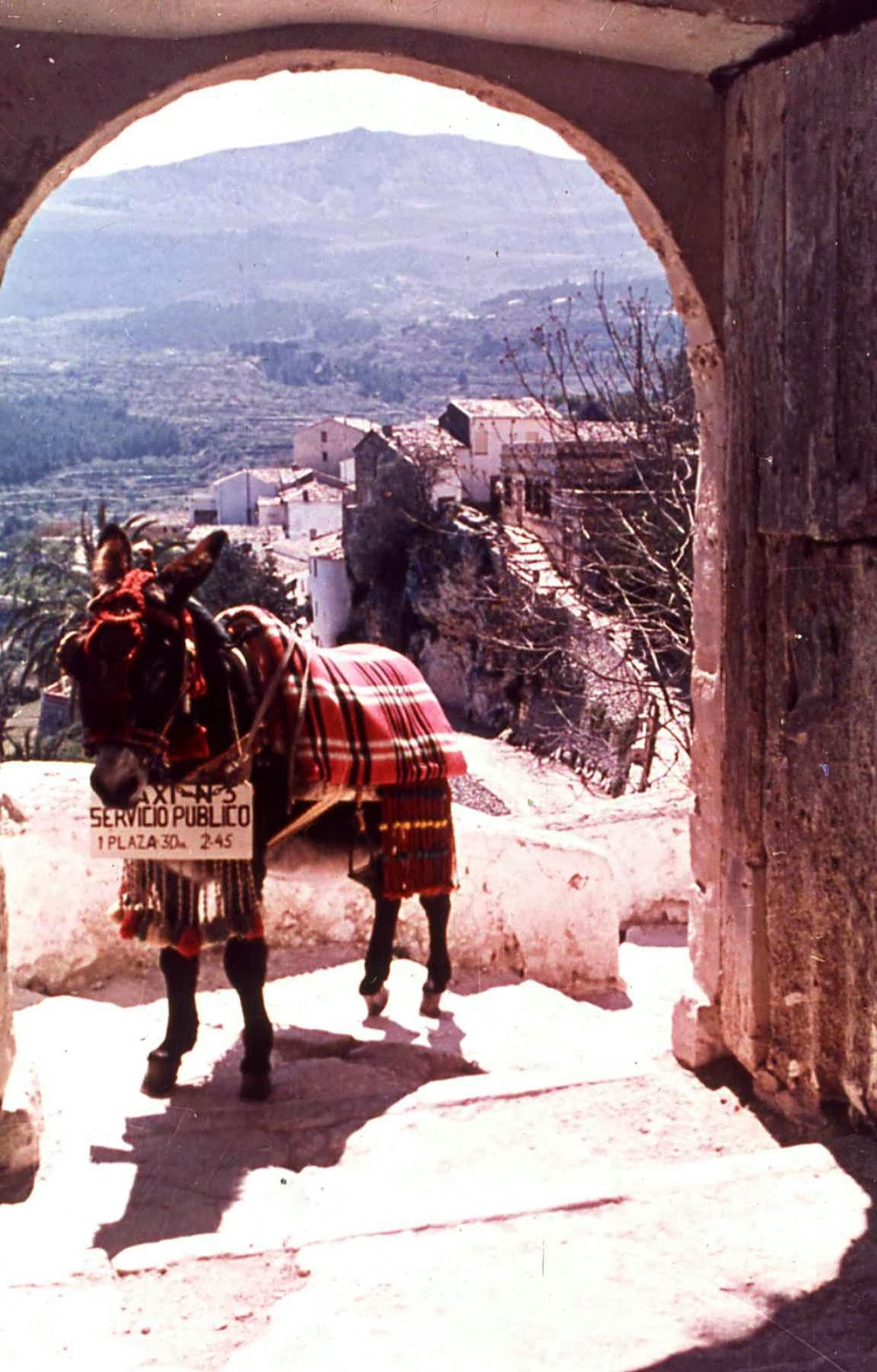
The amazing village of Guadalest near Benidorm in Spain is built literally into the rocks at the top of a mountain, a place where it is impossible to drive a motor car.  It is very popular with tourists who are dropped off from their coaches on a car park way below the village itself, where they are left to walk up the steep paths and steps to reach the village.  All is not lost however because it is possible to get a taxi, but it would have to be one of the licensed ‘donkey taxis’ which ply for hire.


Prison guards


Thun is a pretty little town in the Bernese Oberland of Switzerland which lies on the River Aare at the point where it flows into Lake Thun.   A fine castle, which dominates the town, also houses a small prison.   A nice story is told about the ‘prison guards’ in the shape of a flock of geese which occupies a small area alongside the building and are said to be the best possible guards.


Schwarze Katz
 
The Mosel Region in Germany is noted for its fine wine.  Each village has its own distinctive vineyards and it is easy to find a wine which is suitable to ones taste.    The wine from the village of Zell is particularly notable and is known as ‘Schwarze Katz’ or Black Cat.   Legend has it that in 1863, three wine merchants from Aachen were in Zell to taste the wine and find out which was the best cellar to buy from.  In one particular winery they went into lengthy negotiations and finally they opted to choose from three casks.  Suddenly the owner’s black cat sprang onto one of the casks and arched its back in a threatening manner, whereupon the merchants took it as an omen that it was the best wine and without even tasting it, they bought it.   Since that time, Zell wine has been known as ‘Schwarze Katz’.


The Bridge Monkey
 
Just alongside the town gate on the bridge over the River Neckar at Heidelberg in Germany there is a bronze monkey or ‘bruckenaff’ holding a mirror. Installed in 1979 it was sculptured by Professor Gernot Rumpf and the theme of the sculpture is ‘humility’.   Alongside is a plaque which reads:
“Why are you looking at me?
Haven’t you seen a monkey in Heidelberg?
Look around and you will probably see
More monkey’s like me”.
 
Old drawings show that there was a brass monkey at this spot as far back as the 15th century when a traveller abroad brought a real monkey back to Heidelberg. The local people were amazed to see it and just stared at it – hence the legend. The original bronze disappeared during the Palatinian War of Succession of 1689-1693.
To touch the bronze is said to bring good luck!


Largest Cuckoo Clock

 
The largest free-hanging cuckoo clock in the world can be seen suspended outside a shop in St Goar on the Middle Rhine in Germany.  Some 33 years old, this time piece is 3.5 metres high and 2.5 metres wide.  It weighs about 5 cwts.  Carved from linden wood it is entirely handmade and handpainted.  Because the clock has two faces, the biggest problem faced by the designers was to arrange the working so that a cuckoo pops out on both sides to call time every half hour.  Music also plays as a stage at the top of the clock revolves, revealing a set of four dancing figures.


Lier Sheepheads


The people of Lier in Belgium are known as Schapekoppen or ‘Sheepheads’ .  The story goes that in the Middles Ages the populace had a choice of having a university or a flock of sheep, and they chose the sheep.  Nevertheless the town prospered and the economy of the town is textile industry.


The Elwedritsch
 
The Elwedritsch is a mythical egg laying creature with a long beak, described as chicken like with  small antlers. It has scales instead of feathers and the wings are of little use.  It supposedly originates from the cross breeding of domestic fowls and mythical wood creatures such as goblins and elves.  It is said to inhibit the area around Neustadt an der Weinstrasse in Germany living mainly in the undergrowth of forests and under the vines.   
 
Elwedritschen  in the Market Square at Neustadt an der Weinstrasse

The creature has increasingly been portrayed by artists as female by adding breasts  The Elwetritsch is supposedly very shy, but also very curious and gullable people are sometimes encouraged to indugle in a hunting process.  A hunting party consists of a "Fänger" (catcher), equipped with a big potato sack and a lantern, and the "Treiber" (beaters). The catcher is led into the woods where the Elwetritsch is supposed to live, instructed to wait in a clearing with his sack and lantern, while the beaters will supposedly disturb the Elwetritsch. The light of the lantern is said to be attractive to the curious creature, so it will come to investigate and will then be caught by the catcher. While he waits, everyone heads back to the pub to wait for the catcher to realize that he has been fooled!


THE LION OF GILLEPE


A huge dam was  built near Verviers in Belgium in 1878 to hold back the waters of the Gillepe, a tributary of the Vesdre, which created a large reservoir to supply the area with drinking water.  One hundred years later the dam was raised to a height of 62 metres and a length of 320 metres, providing a capacity of 26 million cubic metres.  The dam is dominated by a huge stone lion constructed by A.F Boure in 1878.


De Moeflon

These beautiful wild sheep, De Moeflon, with huge curly horns can be seen in the forests of The Veluwe in the south east of the Netherlands. They were introduced to the area in the 18th century from Corsica and Sardinia and relatively small numbers have survived to the present day.

A very fine sculpture of one of these animals can be seen on the edge of the forest just behind the railway station at Nunspeet.  


Mystery


I took this photograph many years ago alongside a canal near to Gouda in Holland.
I have never been able to find anything about it although it would appear to have a 'story' attacvhed to it. 


Wednesday, 4 December 2013

CURIOUS ANIMAL STORIES - Miscellaneous 2


A concrete managerie


A curious menagerie garden to be seen in the small village of Branxton in Northumberland was the work of joiner John Fairington. In 1961 at the age of 80, John began to make life sized concrete and cement animals to amuse his handicapped son Edwin. When he died 20 years later, John had acquired a vast menagerie of some 300 animals and other figures which completely took over his back garden. Inscriptions and verses abound in this ‘jardin imaginaire’ which is freely open to the public.


The Mouse


The tiny village of Kilburn nestles at the foot of the Hambleton Hills near Sutton Bank in North Yorkshire and is the home of a very famous animal, a mouse! Which is the trademark of a local wood carver.   The ‘Mouseman’, Robert Thompson, was born in Kilburn in 1886 and followed his father into the trade of wheelwright.   Robert was very fond of carving wood and loved English oak – ‘ No other wood has the same character as oak, and this is the medium with which I can express my feelings,’ he is quoted as saying to a monk at nearby Ampleforth Abbey who had recognised the young man’s skill.    Robert was commissioned for work at the Abbey and soon developed an interest in carving church furniture, although it was not such lucrative work at that time.   One day he thought of the expression ‘poor as a church mouse’ and had the idea to carve a mouse on his work.

Since that time the little mouse has appeared on all Thompson furniture and carvings and is renowned in churches and home throughout the country.    Many examples can be seen in churches everywhere, notably in York Minster and in Westminster Abbey.   Just look for the little mouse.   Robert Thompson died in 1955 aged 79 years and his half timbered cottage still stands in Kilburn close to the modern workshops where the Thompson family tradition is carried on by his family.   A visit to the workshops and showrooms is an enlightening experience and the mouse can be seen in action on most of the furniture in Kilburn church.


The mouse in Kilburn Church


The mouse at The Star Inn, Harome


The Canongate stag


A fine stag's head on the wall inside Jennie Ha's pub in Edinburgh's Canongate came from a stag which was killed in nearby Holyrood Park by a man called Eck as he walked to work one morning at the pub. The stag was running amok amongst tourists in the park and at great personal risk Eck ‘nutted’ the stag twice knocking it insensible and then wrested it to the ground finally finishing it off with his knife.
This also reminds us that Canongate’s emblem is a stag’s head deriving from a story that King David 1 was hunting in the park in 1128 when a stag charged and knocked him off his horse and wounded him. To fend it off the King reached out and clutched a cross he saw in its antlers. The cross came away in his hand and the stag turned away and left him alone. Thankful to be alive, the King asked the Augustinian Canons to build the Abbey of Holyrood on the spot – the ‘Church of the Holy Cross’.


Wild boar
 
Ripley near Harrogate in North Yorkshire is a small estate village connected to Ripley Castle.
This estate has belonged to the Ingilby family since the 14th century.  Thomas Ingilby  (1290-1369), who descended from a noble line dating back to the Norman Conquest, held high office in the judiciary during the reign of King Edward 111.  In 1355, while hunting wild boar with the King in the Forest of Knaresborough, Ingilby prevented the King from suffering serious injury or even death by killing a wounded boar that was about to attack the King. The King knighted him and granted him a Charter for a weekly market and annual fair at Ripley.
Sir Thomas adopted a boar’s head into his coat of arms.


Ripley wild boar


Boar's head door knocker at Ripley Castle


Killed   by  a ‘tyger fierce’


A poignant gravestone in the Abbey graveyard at Malmsbury in Wiltshire is a stark reminder of the days when the Circus came to town, in this case as far back as 1703.  33 years old Hannah Twynnoy was a maid at the White Lion Hotel in Malmsbury.  She died on October 23rd, 1703, after being savaged by a lion.   The epitaph on her gravestone reads :

In the bloom of life

She’s snatchd from hence

She had not room

To make defence

For Tyger fierce

Took her life away

And here she lies

In a bed of clay

Until the Resurrection Day.


Hannah's gravestone


Charlie the elephant


Soon after the Second World War, Billy Butlin opened one of his largest holiday camps on the outskirts of Filey on the Yorkshire coast.  The camp was serviced by its own railway station and had absolutely everything for the complete holiday for 11,000 people, with 1,000 staff.
In 1961 a tragedy occurred at Butlins – the keeper of Charlie the elephant – died.  Charlie, a firm favourite with young and old, then became quite violent and bad tempered and was totally inconsolable.  The problem was so great that eventually Charlie had to be put down.   His stall was sealed off and he was gassed by the fumes from a lorry.  He was buried at the side of the elephant house.
The camp closed down in 1983 and in 1989 the buildings were demolished when the site became derelict.   At the turn of the century permission was granted for the site to be re-developed.   What a shock for somebody should they uncover Charlie’s remains!


Deriliction at Butlin's


The Hartlepool Monkey


A cast iron monkey which can be seen alongside the lock which gives access to the inner harbour at Hartlepool in the North East of England is used to collect coins for charity.  It reminds us of the story that a French ship was wrecked off the headland during the Napoleonic Wars. Apparently the only survivor was a monkey which was dressed in a French Sailors’ uniform, probably the ships mascot.  The simple fishermen who found the monkey had never seen a monkey before, nor had they seen a Frenchman, and they assumed that it was a French spy.  They put the monkey on trial and it was sentenced to death. The ceremony was duly carried out on the beach when the monkey was hanged as a spy.


The Hartlepool monkey


Whalebone arch


The port of Whitby in North Yorkshire reached its hey day in the 18th century when it was the centre of the whaling industry.    The only reminder of those times is the fine ‘whalebone arch’, a curiosity which is preserved on the West Cliff.

Another ‘whalebone arch’ can be seen at the entrance to a private house drive in the village of Threekington in Lincolnshire.   The local squire had business interests in the whaling industry in the 19th century.


Threekington

 
Whitby


Kirkdale Cave


In 1821 quarry men, working in a quarry alongside Hodge Beck in Kirkdale near Kirkbymoorside in North Yorkshire, uncovered a cave in which they found a large amount of bones.   Dr Buckland, Professor of Geology at Oxford, explored the 100 yards long cave  and found the remains of no less than 200 hyenas, as well as the bones from a huge variety  of wild animals and tools and weapons of Stone Age man.   The animals included woolly and slender nosed rhinoceros, lion, mammoth, hippopotamus, European bison, reindeer, wolves, bears, straight tusked elephants, wild ox and deer.   This find rocked the scientific thinking world and put new ideas about what had in fact happened in the far distant past.   Dr Buckland concluded that the cave had been a hyena lair and that the other remains were of animals dragged there by the hyena’s for food.
It seems that Kirkdale Cave was originally a river cave which was left well above the river level after the retreat of the ice during the last phase of the ice-age.  There were times of warmth between the glaciated periods and it was during the last of these which spanned something like 50,000 years, that the hyena’s came to Kirkdale and left the remains, proving that Britain had once been the home of animals which up to that time had been thought to be far removed from these shores.   A truly remarkable discovery.


Kirkdale cave


The Three Wise Monkeys


A troop of monkeys to be seen at The Highland Wildlife Park in Scotland are Japanese snow monkeys and are the origin of the 'Three Wise Monkeys'. Shinto priests at Kyoto have thought of these monkeys as messengers to the gods for some 1500 years.
The Japanese character for monkey is pronounced as 'saru' ('zaru; means not). A play on words led to the monkey being used with phrases : Mizaru, Kikazaru and Iwazaru = 
see no evil, hear no evil, speak no evil.


Snow monkeys