Tuesday, 4 February 2014

SOME PUBS WITH A STORY TO TELL - South and West.1


Ye  Old  Fighting  Cocks  Inn


If you take the footpath leading down from the cathedral at St Albans in Hertfordshire to the River Ver, you will find there on the riverside,  Ye  Old  Fighting  Cocks  Inn,  said to be the oldest licensed pub in England.  The octagonal timber-framed building, which has monastic origins, may have started life as a pigeon cote, and a place where cock fighting took place – hence its name.   Before becoming a fully licensed pub it was a medieval fishing lodge.


The  Half  Moon  Inn


The Half Moon Inn  at Wilstone in Hertfordshire was the scene of an unusual Coroner’s Inquest back in 1751, it was held to inquire into the death of an alleged witch.    Ruth Osborn had been accused of witchcraft following an incident whilst she was begging for food at Gubblecote, her subsequent mutterings being interpreted as a curse.  Notices were posted that she and her husband would be publicly ducked at Wilstone on 21st April 1751.   Despite resistance, they were dragged from their place of refuge in the church vestry by a mob said to number some 4,000 people.  They were repeatedly ducked in the pond at Wilstone, which resulted in the death of Ruth Osborn who had been physically held under the water by the village chimney sweep, Luke Colley.  Colley was subsequently convicted of murder and was hanged at Hertford Gaol on 24th August 1751 and his body was hung in chains at Gubblecote.


The Hole in the Wall

 
There are several pubs with this name. This one, situated at Balkerne Gate in Colchester, Essex, was actually built alongside the Roman wall which once surrounded the town. This is the oldest part of the wall where once stood a triumphal arch which was raised in honour of Roman Emperor Claudius in AD 43 when Colchester was known as Camulodunum and the capital of Roman Britain. The scant remains of the gate are the earliest and most complete Roman gateway in the country

 
This pub was originally called The King’s Head, but in 1843, when the railway came to Colchester, the landlord of this ancient pub saw the opportunity to increase business by removing part of the wall to open up a view from the new railway. Quite amazingly he removed not only part of the wall but part of the old gateway. Thus the pub became known as The Hole in the Wall, a name which was officially adopted in the 1960’s.


The Playhouse

 
This pub in St John’s Street, Colchester in Essex is another innovative Wetherspoon conversion.  Originally opened as The Playhouse Theatre in 1929, it became a cinema in 1981 and subsequently a bingo hall before remaining empty until 1994 having retained its original interior. It was tastefully turned into a pub where the circle and boxes are preserved with models audience without being used. The stage is also still intact where one can enjoy a pint at one of the tables overlooking the auditorium wherein other tables are around a circular bar.


The  Royal  Huts  Hotel


Five paintings in  The Devil's Punch Bowl Hotel, formerly The Royal Huts Hotel, at Hindhead in Surrey tell a story of brigandage in the 18th century,  


© Copyright Colin Smith and licensed for reuse under this Creative Commons Licence.

To whom Iam grateful for the use of his Geograph photograph. 


A memorial on  Gibbet Hill marks the spot where a sailor was murdered and where three  villains were hanged in chains, which are also preserved at the hotel.   The full story is also told on the gravestone of the unidentified victim who was buried in the churchyard at  nearby Thursley :

‘ In memory of a generous but unfortunate sailor

who was barbarously murdered on Hindhead

on September 24th 1786 by three villains

after he had treated them liberally and promised them

further assistance on the road to Portsmouth.’


The  Bat  and  Ball


The old Bat and Ball Inn, once used as the clubhouse for an ancient cricket club stands alongside the ground on Halfpenny Down north east of the village of Hambledon in Hampshire.  This is the spiritual home of cricket where Hambledon Cricket Club, founded in 1760, gradually developed the laws of the modern game.   A granite monument in a corner of the cricket ground marks the hallowed site.


Hambledon Cricket Ground


The  Trusty  Servant  Inn


This village inn at Minstead in the New Forest has a curious name, the origin of which lies in a picture at Winchester College,    The Trusty  Servant  embodies a pig which will eat any scraps;  a padlock which shows that he will tell no tales; stag’s feet for swiftness; and a laden hand for hard work.  A useful fellow to employ.


Sir Arthur Conan Doyle is buried in the nearby churchyard.


The  Sir  Walter  Tyrrell  Inn


This New Forest inn,  The Sir Walter Tyrrell,  gives its name to the man  thought to be responsible for the death of King William 11.   The Rufus Stone, which can be seen in a clearing nearby at the side of an unclassified road north of the A31, recalls the death of King William 11 (1056 – 1100).  It was erected in 1745 to replace a tree which had marked the original spot where William Rufus was killed by an arrow whilst hunting in the New Forest.   But was the death an accident ?   Called Rufus supposedly because of his ruddy appearance, William was a man, so it is said, who was ill tempered and small both in body and in mind.  He was loathed by his people and few tears were shed when he was killed, and indeed the clergy at Winchester Cathedral refused religious rites to his remains.


Whilst his death was probably an accident,  Tyrrell has  by tradition been suspected of being responsible.   Was it an accident or was it regicide?  We will never know.    The Sir Walter Tyrrell Inn  can be found nearby.  


© Copyright Jonathan Kington and licensed for reuse under this Creative Commons Licence.
To whom I am grateful for ther use of his Geograph photograph.
 
 
The former forge at nearby Avon is where, according to legend, Sir William stopped before fording the river, and made the blacksmith reverse his horse’s shoes in order to mislead his pursuers, whilst fleeing the scene.


The Forge at Avon


The  Crown  Inn


Back in the 12th century, King John,  another unloved King,  had occasion to spend the night at the  Crown Inn  at Kingsclere in Hampshire and spent a very uncomfortable night being severely bitten by bed bugs.  The King had been following his favourite pursuit of hunting in the area when a thick fog had prevented him from returning to the Royal apartment and hasty arrangements had been made for his accommodation at The Crown..    The story goes that as a result of this unfortunate experience, the King ordered that an effigy of a bed bug be displayed on the church tower,  and so a rather regal bed bug weathervane is to be seen on the church tower to this day.


The  Snakecatcher  Inn


The Snakecatcher Inn at Brockenhurst, also in the New Forest tells a quite different story about an interesting local character who died in 1905 at the age of 67 years.   Harry Mills, who was better known as Brusher Mills, lived in an illegal shack in the forest for almost 30 years,   actually the shack burned down just one day before the 30 years required to claim the home and land upon which it stood under ancient forest law.   He was known as Brusher simply because of the meticulous way in which he brushed the village cricket pitch.   His main occupation however, was that of snake catcher  and he is credited with having killed a total of 3,186 New Forest adders, which he sold to London Zoo as live feed for the larger snakes.
Mills was buried in the old churchyard just outside the village where a very fine marble stone marks his grave.  The stone depicts a carving of  Mills


The Hare and Hounds


The Hare & Hounds is a thatched pub in Downend Road at Arreton on the Isle of Wight and has a micabre connection to a local murder.   Close by is the curiously named Burnt House Lane and also a Bronze Age barrow known as Morey’s Hump.
In 1736, an elderly woodcutter called Michael Morey lived in an old cottage, in what is now called Burnt House Lane, with his grandson James who was 14 years of age. In June of that year, the boy’s dismembered body was found concealed in leather bags in nearby woods together with a billhook and bloodstained gloves.  Morey had set fire to his cottage and absconded. He was subsequently arrested and convicted of the murder at Winchester and executed. His body was hung in chains from a gibbet which was erected on the barrow at Arreton.
The gibbet cost the parish £6 and it was later sold to the landlord of the Hare & Hounds to recover some of the cost. The 22 foot upright was used as a beam in the pub tap room.
 

Hare and Hounds public house


© Copyright Chris Allen and licensed for reuse under this Creative Commons Licence.
To whom I am grateful for ther use of his Geograph photograph.


Burnt House Lane


The Pilot Boat Inn


As seen in the photograph, this pub at Bembridge, Isle of Wight, is partly built in the shape of a boat.


© Copyright Ian S and licensed for reuse under this Creative Commons Licence.
To whom I am grateful for the use of his Geograph photograph.

Monday, 3 February 2014

SOME PUBS WITH A STORY TO TELL - Midlands 2


The  Mug  House


The only known pub to stand in a churchyard is The Mug House which stands on consecrated ground alongside the churchyard of Claines parish church near Worcester.  This timber framed pub is 600 years old and was used as a coaching inn to cater for the aristocracy who had a distance to travel to the church.   The name ‘mug’ may be connected with old time communion plate or perhaps it simply related to the clinching of a deal over a ‘mug’ of ale.  Although much altered over the years it still retains the air of an ancient inn.


The  Slip  Inn


It is not unusual for a pub to be called  The  Slip  Inn,  a place to slip in for a quick drink!   However,  The  Slip  Tavern  at Much Marcle in Herefordshire is a bit different and recalls an unusual event which occurred nearby in the year 1575 -  ‘ the wonder land slip’, as depicted on the inn sign.   Apparently Marcle Hill started moving at 6.0pm on 7th February of that year and was still moving three days later, during which time some 26 acres of the hill moved a distance of 400 yards, leaving a trail of destruction in its wake.  It crossed two roads, demolishing a chapel, trees were uprooted and livestock was killed.    No logical explanation has ever been found for this landslip.


Ye  Olde  Trip  to  Jerusalem  Inn


A claimant for the oldest pub in England title,  Ye  Olde  Trip  to  Jerusalem  Inn at Nottingham, is certainly one of the strangest old inns.  Situated in Brewhouse Yard beneath Nottingham Castle, the cellars of the inn are actually cut into the great rock on which the castle stands.   The pub certainly dates back to the time of the Crusades and it is said to have been well frequented by the Crusader’s. 


 © Copyright JThomas and licensed for reuse under this Creative Commons Licence.

To whom I am grateful for the use of his Geograph photograph


The  Royal  Children  Inn


This strangely named pub in Castle Gate at Nottingham,  The  Royal  Children  Inn, once had an even stranger sign, in the form of a whale’s shoulder blade!  (Now preserved inside the pub), This inn on the site of an older inn in Castle Gate near to Nottingham castle, once sold whale oil to fuel lamps which had replaced candles for lighting purposes.  It is said that the children of Princess Anne, the daughter of King James 11, used to play with the innkeeper’s children, hence the name.


The  Cuckoo  Bush  Inn 


You may not wish to linger in the village of Gotham in Nottinghamshire when you hear about the antics of the locals, but then it all happened a long time ago, and it explains the origins of The Cuckoo Bush Inn in the village     It actually relates to the 16th century ‘ Merrie Tales of the Mad Men of Gotham,’  which tells of the antics of a crazy group 'who built a hedge around a cuckoo in a bush to keep it and spring all the year round.  They also tried to drown an eel, put a cart on top of a barn to protect the roof from the sun and burned down a forge to get rid of a wasps nest.'  Although referred to as ‘mad men’, their antics may have been designed to deter King John from building a hunting lodge in the middle of such a crazy village!


The  Bramley  Apple  Inn


An apple tree which was grown from a pip in about 1805, became famous as the Bramley apple tree.  Fifty years later Mr Bramley, of Easthorpe, Southwell in Nottinghamshire,  allowed grafts to be taken on the condition that they carried his name and so perpetuated the name Bramley.   The original tree still grows in the garden behind Bramley Tree House at Easthorpe and gives its name to the local pub, The  Bramley  Apple  Tree  Inn.


Mr Bramley's garden


The Tin Hat


The Tin Hat pub in Trent Road at Hinkley in Leicestershire is a relatively modern pub which was built on a housing estate on the outskirts of the town in the 1980’s. The pub got its name as a result of a competition for that purpose.


Hinkley was known for many years as ‘Tin ‘At’ supposedly as a result of a supposed incident when a 19th century itinerant sheep drover, who was drinking in a local pub, bragged that he could drink a hat full of ale. It is said that the landlord put the man to the test by having a tin hat made by a local blacksmith – apparently it held some 34 pints of ale. We are not told whether or not the itinerant completed the task.
A tin hat certainly appears on the town coat of arms and a tin hat can be seen on the top of a flag pole belonging to a local building society.


Another explanation for the tin hat is that it originated as a metal bucket placed on top of the town water pump to keep the water clean, something that was probably given the derisory name of tin hat by drunken visitors to the town making it a derogatory item.
It appears that there was a tin hat which changed hands on a number of occasions and it, or a replica, is said to be in possession of the local civic society.


The Bear Inn


In 1766, The Bear Inn at Bisley in Gloucestershire moved its business from its former building where it had been trading since 1639, to its present location in a very fine Tudor building, with later Jacobean and Georgian additions, in George Street. This building was formerly the village Court house and Assembly Rooms with five Jacobean columns supporting the upper floor at the front of the building. It retains many of its historic features and a fine 17th century Inglenook in the bar. The rock hewn cellars contain a well said to be 58 feet deep.


The Cheese Rollers


This village pub at Shurdington in Gloucestershire is close to Cooper’s Hill and reminds us of  a strange contest which takes place each year at May Bank Holiday and has done so for at least 200 years. Quite simply, a 7lb double Gloucester cheese is rolled down this very steep grassy hill to be chased by the competitors. It is said that the slope has a gradient that is in places 1 in 2 and in others 1 in 1, its surface being very rough and uneven and it is almost impossible to remain on foot during the decent.  Although the aim is to catch the cheese which reaches a speed of up to 70 mph, this is not likely to be achieved and the winner is the one who reaches the finishing line first, with the cheese being the prize. The event has been summarised as “ twenty young men chase a cheese off a cliff and tumble 200 yards to the bottom where they are scraped up by paramedics and packed off to hospital.”  Sprained ankles, broken bones and concussion are the usual injuries but the event remains ever popular attracting competitors from all over the world.


Cooper Hill
 

SOME PUBS WITH A STORY TO TELL - Midlands 1


The Little John Inn


The Little John Inn at Hathersage in Derbyshire reminds us that Robin Hood’s trusty lieutenant,  known as Little John, is reputed to have hailed from there.    A huge grave in the churchyard at Hathersage is claimed to be that of this man, having died in a nearby cottage.   In 1847, the occupant of the cottage, Jenny Shard, a woman of 70, who had had the story from her father and which had been handed down in the family, remembered the grave being opened by Captain James Shuttleworth, when a thigh bone 32ins long had been found, indicating that it was of a very big man.   Added to the story is the fact that there was at one time in the church a long bow and cap, said to have belonged to Little John.   At some stage they were taken away for safe keeping?  by the local squire and their present whereabouts are not known.


The  George  and  Dragon  Inn


Perhaps the man who painted the clock face on the church at Old Brampton near Chesterfield in Derbyshire  spent too much time at the George and Dragon Inn  opposite    Time goes by at a leisurely pace in this small village and one of the reasons for this is probably due to the fact that the church clock has 63 minutes marked on it. 


The  Rutland  Arms  Hotel


The cook at  The Rutland Arms Hotel,  a very impressive old hostelry at Bakewell in Derbyshire, made culinary history in the mid 19th century when she inadvertently produced the recipe for  Bakewell Pudding.   Instead of stirring the egg mixture into the pastry and then filling the tart she was making with jam, the cook put the jam into the tart first and then poured the egg mixture over it.  A simple mistake, but the resultant dessert was so successful that it became  established  and has been made at the Bakewell Pudding Shop across the road since about 1860.


The Miner’s Arms


This old village pub at Eyam in Derbyshire dates back to the early 17th century.  We are reminded of an unusual incident which took place in the pub in 1684 when the village rector, The Rev. Joseph Hunt took part in a mock marriage between himself and the landlord’s 18 years old daughter Ann.  This bibulous frivolity proved to have dire consequences for the rector, because when the bishop heard about it he made the Rev. marry the girl properly, despite the fact that he was engaged to another woman.  We are not told whether the marriage survived.


The  Cock  Inn


The  Cock  Inn  at Hanbury in Staffordshire had to be rebuilt in 1944 when it was blown up
by a tremendous explosion. 


A plaque on a memorial stone alongside a huge crater nearby,  tells the dramatic story:

‘ Just after 1100 hours on 27th November 1944, the largest explosion caused by conventional weapons in both world wars, took place at this spot, when some 3500 tons of high explosives accidentally blew up.  A crater some 300ft deep and approximately a quarter of a mile in diameter, was blown into the North Staffordshire countryside.   A total of 70 people lost their lives and 18 bodies never being recovered.  The 21 MU RAF  Fauld disaster is commemorated by this memorial, which was dedicated on 25th November 1990, some 46 years after the event.


 -

As a  board outside the pub tells you, you can find the story of the explosion here at The  Cock  Inn.


The Bull and Spectacles
 

This   
This    This curiously named pub at Blithbury near Uttoxeter dates back to c1650 and was originally known as ‘The Bull’.  The story goes that one evening, a drunken customer climbed up onto the pub sign and put his spectacles on the bull. Another story tells that a prize bull nearly died after eating some poisonous berries and a local wag suggested that it should be fitted with spectacles.  Whatever the reason, the name of the pub was changed.


The  Crooked  House  Inn

 
            Make sure that you are stone cold sober before you approach  The Crooked  House  Inn at Himley in Staffordshire, where customers stagger in the doorway even before they have sampled the fine ales on sale here.   This curious building has been freakishly distorted by mining subsidence and it is difficult to walk properly anywhere in the place.   Once you have managed to orient yourself in these unusual surroundings, you will be further startled to find that on one table the bottles roll uphill!


The Tontine Hotel

 
Situated directly opposite the bridge at Ironbridge in Shropshire is a very fine building,  
The Tontine Hotel. 
           When  the Iron Bridge was opened to general traffic in 1781, it was to become a huge attraction not only to those who would use the bridge but also to visitors from all over the world who would marvel at this great feat of engineering and skill.  Those concerned with the building of the bridge decided to build a hotel to accommodate such visitors and formed a partnership which was a ‘Tontine’.  This was  a scheme invented by one Lorenzo Tonti in 1653, a kind of life annuity which increased for the survivor’s as the subscriber’s eventually died.   When only three shareholders were left, then the hotel would become their property in proportion to the number of shares which they held.


The  Four  Alls  Inn


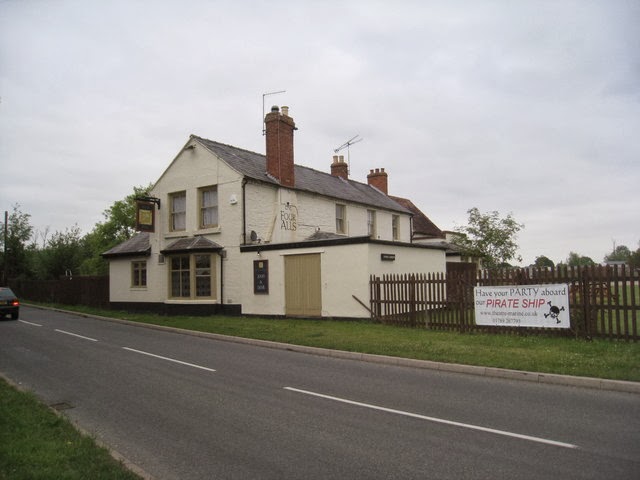
This village pub at Welford-on-Avon in Warwickshire bears the curious name,  The Four Alls Inn.   The explanation is to be found inside on a very fine stained glass window in the bar which depicts four figures, and these are  The Four Alls :   1.  A soldier = fight all;  2.  A priest =  pray all;  3.  A king  =  rule all;  4.  A peasant = pay all.


The Four Alls 
 
 © Copyright Jonathan Thacker and licensed for reuse under this Creative Commons Licence.
 To whom I am grateful for the use of his Geograph photograph.


The Castle Inn


The Castle Inn at Radway in Warwickshire, situated on Edge Hill, actually started life as a castle albeit a sham castle.   On the centenary of the  Battle of Edgehill, gentleman architect and owner of Radway Grange, Sanderson Miller, erected this building on the very spot where Charles 1 raised his standard on the 23rd of October 1642, thus launching the first major encounter of the Civil War.  As well as marking the site of this historic battle, the sham castle  also  functioned as an ornamental gatehouse for Mr Miller’s estate.  The building became a pub in 1924.