Bakewell Pudding
Talk of Bakewell in Derbyshire
and one immediately thinks of Bakewell Pudding or Tart. The recipe for this desert was discovered by
accident as the result of a misunderstanding between the cook and the mistress
at the Rutland Arms Hotel in Bakewell.
Instead of stirring the egg mixture into the pastry and then filling the
tart she was making with jam, the cook put the jam into the tart and then poured
the egg mixture over it. The resulting
desert was so successful that it became renowned as Bakewell Pudding and is sold today in the Bakewell Pudding shop.
Sally Lunn
In 1680 a Hugeunot girl refugee called Soli Luyan, later Sally
Lunn, arrived in Bath and found
employment with a baker in Lilliput Alley. She told the baker about the French
brioche type of bread or buns which were to become famous and forever
associated with her name. This light and delicious bun soon became popular at
afternoon tea’s which were part of Bath’s tradition.
The baker’s premises are still there and said to be the
oldest building in the city, probably dating back as far as AD200.
Sally’s kitchen and contents, in use up to the late 19th
century. is still preserved in the cellar where it can be visited. Present day Sally Lunn’s can also be enjoyed
in the refreshment rooms above, indeed the rich round buns are still made in a
modern bakery on the second floor.
Sally’s original recipe was found in a secret cupboard in
the 1930’s and is passed with the deeds to the building.
Starry Gazy Pie
A culinary delight in Cornwall is Starry
Gazy Pie
- a fish pie. Legend has it that Mousehole fisherman, Tom
Bawcock, saved the population from starvation when he sailed in a huge storm to
return with seven different types of fish.
They were all baked together in a huge pie to feed the starving locals.
They still celebrate ‘Tom
Bawcock’s Eve’ every year on 23rd December at the Ship Inn in
Mousehole.
Denby Dale Pie
The small village
of Denby Dale near Huddersfield in West Yorkshire
is known as the ‘Pie
Village’ as a result of
its long tradition of baking huge celebratory pies. The very first pie was made in 1788 to
celebrate George 111’s recovery from mental illness. No.2 was to celebrate Victory at Waterloo. No3. celebrated the repeal of the Corn Laws
in 1846. No.4 was baked to celebrate
Queen Victoria’s
Jubilee in 1887, but sadly this time the pie went bad and had to be buried in a
nearby wood. However, within one week a
‘resurrection pie’ was produced as No.5.
No.6 celebrated the Corn Law
Jubilee in 1896. In 1928 it was
resolved to bake a pie to raise money for the endowment of a bed at
Huddersfield Royal Infirmary and so ‘The Infirmary Pie’ became No.7. The next pie, No.8 was to raise money for
the pensioner’s Community Centre. This
‘Darby and Joan Pie’ was baked in 1964 and the pie dish, 18 feet long, can be
seen in front of the Pie Hall in the village main street, where it has been
planted with flowers. 3,000 kilo’s of
beef, 3,000 kilo’s of potatoes and 700 kilo’s of onions, were the ingredients
for Pie No.9 in 1988 and pie No.10 ‘The
Millennium Pie was baked in the year 2000.


Stilton Cheese
Wikipedia tells us :
Stilton is an English
cheese, produced in two varieties:
Blue known for its characteristic strong smell and taste, and the lesser-known
White. Both Blue Stilton and White Stilton have been granted the status of a
protected designation of origin by the
European Commission, two of only ten British cheeses currently produced to have such protection.
[1] The PDO status requires that only cheese produced in the three counties of
Derbyshire,
Leicestershire, and
Nottinghamshire and made according to a strict code may be called "Stilton".
According to the Stilton Cheesemaker's Association, the first Englishman to market Blue Stilton cheese was Cooper Thornhill, owner of the
Bell Inn on the
Great North Road, in the village of
Stilton,
Huntingdonshire.
[2] Traditional legend has it that in 1730, Thornhill discovered a distinctive blue cheese while visiting a small farm near
Melton Mowbray in rural Leicestershire – possibly in
Wymondham.
[3] He fell in love with the cheese and made a business arrangement that granted the Bell Inn exclusive marketing rights to Blue Stilton. Soon thereafter, wagon loads of cheese were being delivered to the inn. Since the main
stagecoach routes from
London to
Northern England passed through the village of Stilton he was able to promote the sale of this cheese and the fame of Stilton rapidly spread.
However, the first known written reference to Stilton cheese actually predates this and was in
William Stukeley's
Itinerarium Curiosum, Letter V, dated October 1722.
Daniel Defoe in his 1724 work
A tour thro' the whole island of Great Britain notes, "We pass'd Stilton, a town famous for cheese, which is call'd our English Parmesan, and is brought to table with the mites, or maggots round it, so thick, that they bring a spoon with them for you to eat the mites with, as you do the cheese."
[4]
Frances Pawlett (or Paulet), a "skilled cheese maker" of Wymondham, has traditionally been credited as the person who set modern Stilton cheese's shape and style characteristics in the 1720s,
[5][6] but others have also been named.
[7] The recipe for a Stilton cheese was published by
Richard Bradley, first
Professor of Botany at Cambridge University in his 1726 book
A General Treatise of Husbandry and Gardening. Bradley records a letter from a correspondent, John Warner, which states the cheese is made in Stilton and that the Bell Inn produced "the best cheese in town".
[8]


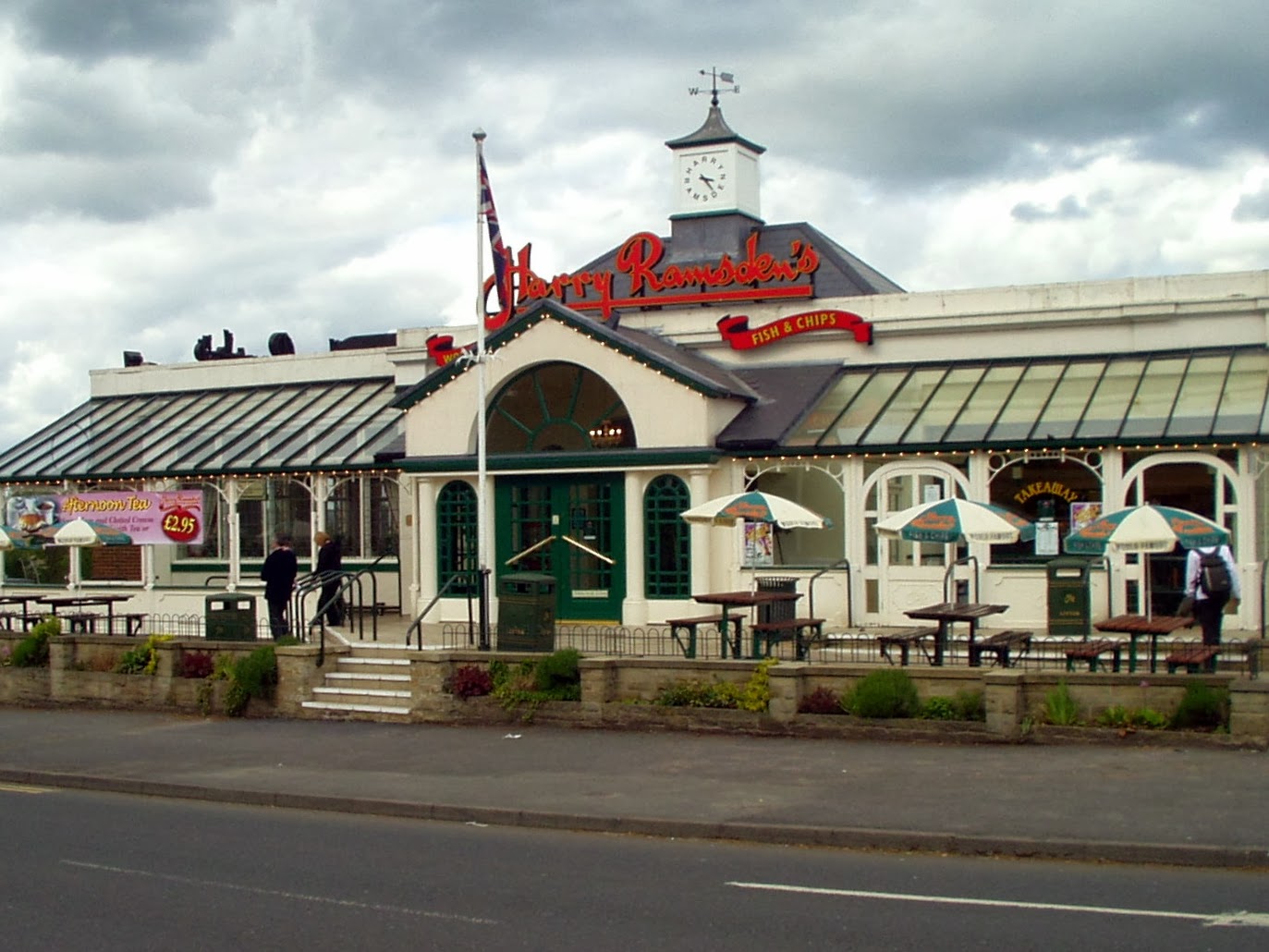
Harry Ramsden's
According to the Guinness Book of Records, the world’s largest fish and chip shop is Harry Ramsden’s at Guiseley in West Yorkshire, with more than 1,000,000 customers per annum.
Actually the Harry Ramsden name was taken over by a large consortium a few years ago. The actual premises have recently been refurbished as The Wetherby Whaler whilst retaining the former opulance and facilities.
Harry Ramsden, a man of great vision, opened his fish and chip shop in a small wooden hut at Guiseley Cross in 1928 at a time when fish and chips were the staple diet of most of the working class population and there was a fish and chip shop at the corner of most streets. The business prospered and Ramsden was able to build a much larger shop nearby to include a luxurious 200 seater fish restaurant. Despite the success of the restaurant, Harry did not loose sight of the importance of the take-away side of the business where the food was cooked to perfection due to Harry’s meticulous planning and cleanliness. Everything had to be, and was, spot on. Starting with just an outside bench for take away customers to sit on, Harry soon provided a few tables and chairs and eventually had the area roofed over to further ensure the comfort of those customers, finally providing cups of tea to complement the meal. Ramsden also provided a delivery service by motor bike and sidecar to provide bulk orders to the nearby factories. Some 10,000 people turned out when Harry Ramsden had his last big fry, at original prices, before he retired and the business was sold. The business, now a national concern, still prospers and has extended to many parts of the globe.
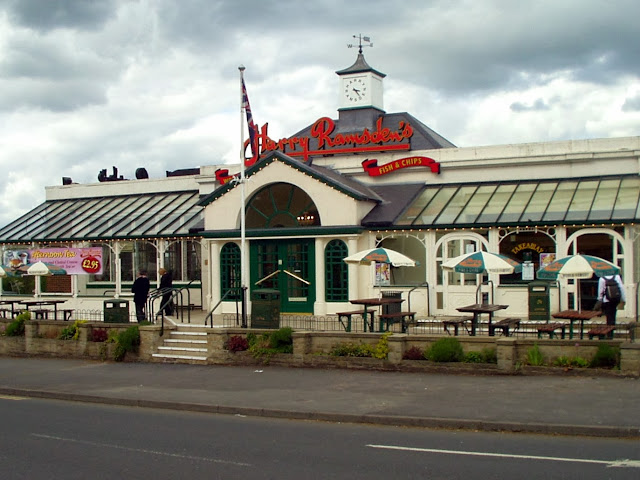


Harry Ramsden’s original hut can still be seen behind the Guiseley emporium.
The Price of
Bread
Tablets set into the
wall of the churchyard at Great Wishford in Wiltshire record the price of bread
since 1800.
In 1800 it was
3s/4d per gallon. In 1801 it was 3s/10d per gallon.
In 1904 it was 10d per
gallon. In 1920 it was 2s/8d per gallon
– after the Great War.
In 1946 – 48 bread was
rationed. Subsidised price was 2s/1d per gallon.
In 1965 it was 5s/4d
per gallon.
In 1971 it was 8/- per
gallon – 40p decimal.
In 1984 it was £1.80
per gallon.
In 2000 it was £372 per
gallon.
Hovis
Hovis is synonymous with brown bread. Golden Hill in the ancient Dorset town of Shaftesbury,
will long be associated with the T.V commercial for Hovis ("He were a great baker were our dad") and a huge plastic
Hovis loaf charity box can be seen at the top of the hill.
The town was founded by King Alfred and King Canute died there in 1035.
Shrovetide
Shrovetide is carnival time derived from the Latin for carne levare, and literally means 'put away flesh.' It is a public festival particularly in Catholic countries just before Lent, usually known as Mardi Gras (Fat Tuesday). We know it as Shrove Tuesday, Pancake Day to us, the day when everybody eats pancakes.
Shrive means to confess for absolution from sin and in pre-Reformation times everyone was expected to be 'shriven ' on the Tuesday before Ash Wenesday, in preparation for the Lenten fast. The rest of the day would be spent in festivity and feasting and the feast for poorer people was pancakes when foods such as eggs and fats, forbidden during Lent, would be used up and nothing was wasted.
The tradition is still maintained and many communities have a 'pancake race' as spart of their festivities.
In Scarborough in North Yorkshire the townspeople were called to confession when a bell was rung early on Shrove Tuesday to remind then of their duty, a tradition which is still maintained when the bell is rung at 12noon to remind housewives that it is time to cook their pancakes and to announce the start of a pancake race.
It seems that the original Scarborough pancake bell was that of St Thomas' Church and when the church was demolished during the Civil War the bell was hung above the entrace to St Thomas' Hospital in North Street. The hospital was in turn demolished and the Pancake Bell ended up at the Rotunda Museum where it continued to be rung by the Mayor at 12 noon on Shrove Tuesday. Sadly, in 1976, the old bell cracked and was preserved for posterity. A ship's bell was used until 1996. The final bell saga was enacted in that year when the Mayor rang a new Pancake Bell, a replica of the original bell, bought by public subscription and erected on a new site in North Street not far from the site of St Thomaas' Hospital.
Whilst the Pancake Race is a relatively new event in Scarborough, the main event of the day is another unique festivity that the town has enjoyed for as long as anybody can remember. that of skipping. Once the pancakes have been devoured, young and old alike gather on the foreshore to spend the afternoon skipping, as their forefather's have done for hundreds of years.
It is said that the tradition may have been started by fishermen using the readily available long ropes.
The largest bottle of whisky
According to the Guinness Book of records, the largest bottle of whisky is to be found at
the Glenturret Distillery near Crieff in Scotland.
The bottle is 5'5" tall and contains 228 litres (50.15gals) of Famous Grouse whisky.
some 8000 drams.
The bottle was made by Czech manufacturer's Bomma at Svetla near Prague.






.JPG)


.JPG)




![Creative Commons Licence [Some Rights Reserved]](https://lh3.googleusercontent.com/blogger_img_proxy/AEn0k_t52MXdVhBsuyelEahtkHCfSSmHb0zgzidQLoDT2VHz0JBm9M46qIVZgSyNWAgn9m8U0jmu9gxJfuNuW1b98G2b-ykrCOmaFiFqDM-jc2sPfeHHbFwrNVj10h1YoA=s0-d)


