Saturday, 28 June 2014

SCOTLAND 10 - Srathspey & Cairngorm Mountains


 The River Spey rises in the Monadhliath Mountains to the east of Loch Ness and flows through a lovely valley alongside the Cairngorm Mountains and north eastwards into the sea on the Moray Coast. 


The Cairngorms are composed mainly of granite and in some places quartz crystals, known as 'Cairngorms' are found.
The range form an extensive group of lofty flat topped mountains stretching from Speyside to Deeside to the north-east of the main Grampian range. The area was designated as a National Park in 2003 and is extremely popular with both walkers and skiers. The Park covers an area of some 1,748 square miles and is the largest national park in the British Isles,


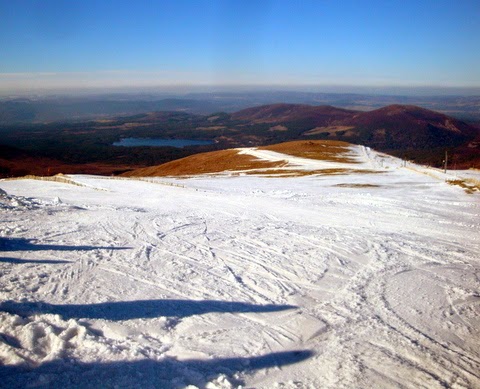
A two kilometre funicular railway ascends the northern slope of Cairn Gorm near Aviemore and is the highest railway in the UK.


The highest telephone box in the UK is near the base station.


The small town of Aviemore is a tourist resort close to the A9 road catering for visitors the National Park. Whilst it is on the Highland Main Railway Line the nicely preserved station is also the southern terminus of the Strathspey Steam Railway which operates for 10 miles from Aviemore to Broomhill.


Kingussie, a small town some 12 miles south of Aviemore also has a fine
railway station.


The railway opened in 1863 as part of the Inverness and Perth Junction Railway, later the Highland Railway. In the summers before WW2 the station was busy just before the Glorious 12th when the shooting parties would arrive. Many trains were specially commissioned for them and some of them had up to 36 carriages which is why these long platforms were so useful.
The record is said to be 46 trains arriving between 4pm and 11pm.
Most of the carriages had no toilet and the station was often used as a comfort break where there were no less than 44 urinals,


Just one mile south of Kingussie, the ruins of Ruthven Barracks stand proudly on a hill on the opposite side of the Spey. The site was originally a 13th century castle later occupied by the infamous Wolf of Badenoch.
The barracks were built by Hanoverian troops in 1719 as a defence for the area after the Jacobean uprising of 1715.  A small garrison of men successfully defended the barracks against a Jacobite army in the early days of the 1745 rebellion but fell to the Jacobites in 1746.
The site is freely open to the public.


Fans of the TV programme Monarch of the Glen will recognise this area as being where location filming took place, especially around Laggan and the early reaches of the River Spey.


This is a good location to see a real monarch of the glen.


You may even catch a glimpse of one of the mountain goats
which frequent this area.


If you are really lucky you may see a golden eagle


If you are not fortunate enough to see any wildlife in the real, you can always see some at the Highland Wildlife Park which is situated between Kingussie and Aviemore, where a variety of animals are kept in a controlled natural environment.


You can get up close to the illusive wild cat which still exists in the Scottish forests, although their numbers have now dwindled to an estimated 100.


Or an even bigger cat which you certainly will not see in the wild in these parts.


One of the most popular enclosures in this park is the monkey area. Here you can see a troop of Japanese snow monkeys.

This species are said to be the origin of the 'Three Wise Monkeys'. Shinto priests at Kyoto have thought of these monkeys as messengers to the gods
for some 1500 years.
The Japanese character for monkey is pronounced as 'saru' ('zaru; means not). A play on words led to the monkey being used with phrases :
Mizaru, Kikazaru and Iwazaru = 
see no evil, hear no evil, speak no evil.


Friday, 13 June 2014

SCOTLAND 9 - Aberdeenshire and Moray


Aberdeen, known as The Granite City, is the third largest city in Scotland.


This statue of Robert The Bruce stands proudly outside Marischal College which was founded in 1593 by Earl Marischal.
The present building dates to the 19th century.


St Machar's Cathedral in Old Aberdeen dates to the 15th and 16th centuries.


Royal Deeside runs westwards from Aberdeen passing Balmoral, the Queen's private residence. Many of Ballater's long established businesses have Royal warrant's and from time to time members of the Royal Family can be seen
in the town.


 Once upon a time the Royal Family would arrive at Ballater railway station on their journey to Balmoral. The station is now preserved as a museum.


The River Dee near Balmoral.


This Isambard Kingdom Brunel bridge crosses the river to give access to the Balmoral estate.


The Queen and the Royal Family worship at nearby Crathie Church when they are in residence at Balmoral.


Queen Victoria's faithful servant, John Brown, is buried in the
old churchyard close by.


Braemar is a fine Deeside resort situated where Clunie Water joins the Dee. Well known for its Highland Games which are attended by the Royal Family
each September.


The Fife Arms, a fine Victorian Hotel, dominates the main street.
Whilst Clunie Water flows nearby to join the River Dee.


In the graveyard at Braemar there is a flat tombstone alongside the Invercauld Vault, in memory of one Peter Grant, known as Auld Dubrach.  He was born in 1714 at Dubrach in Glen Dee and became known as the oldest surviving Jacobite.  He had been taken prisoner at the Battle of Culloden but managed to escape from  Carlisle Castle whilst awaiting trial and returned home on foot to resume his normal trade as a weaver and tailor in Auchendryne where he married and had six children.  When he celebrated his 100th birthday, King George 1V heard about him and granted him a pension of 1 guinea per week.
Aud Dubrach died at Auchendryne in 1824 when he was 110 years old. His funeral was attended by over 100 people and it is said that an ‘anker’ of whisky (about 4 gallons) was consumed before he was interred, and at the graveside a piper played the Jacobite tune, ‘ Wha widna fecht for Charlie’s richt’.


The River Dee rises in the Cairngorm Mountains to the west of Braemar and before reaching Braemar it tumbles through a very picturesque 300 metre natural rock gorge known as the Linn of Dee.


There are many Pictish stones remaining in Scotland.
 
The Maiden Stone at Pitcaple near Inverurie is a good example. Of pink granite, it stands 10 feet tall and is one of the finest examples of a Pictish cross slab in Aberdeenshire.
It dates from about the 9th century.   The creation of the stone is subject of a local legend when The Maiden of Drumdurno made a wager with a stranger that she could bake a firlot of meal before he could build a road to the top of the local Benachie hill.  The stranger was the Devil and of course he finished the road before the bread was baked.  The maiden fled and as the Devil caught up with her she uttered a prayer to God.  At once she was turned to stone and the place where the Devil touched her shoulder is still marked by the cleft in the stone.


Another huge sandstone pictish cross slab stands on the eastern side of Forres. Standing some 21 feet in height the stone has a Celtic cross on one side and a large battle scene on the other. Although the origin is uncertain, it may be that the stone commemorates the defeat of Malcolm 11 by Norse warriors led by Sueno in 1008.
Local legend says that it stands at the cross roads where Macbeth originally met with the three witches who were eventually imprisoned inside the stone.


Fyvie Castle is one of several castles in Aberdeenshire in the care of the National Trust for Scotland. Dating from the 13th century this fine castle has five towers each of which is named after different family owners up to the 19th century.


By contrast there are a variety of ecological houses at the Findhorn Foundation Eco Village on the Moray coast.


Tucked away in a corner are several houses which have been constructed from redundant whisky vats.


The battlemented clock tower situated in the main street of Dufftown was completed in 1839.   It was originally the town jail, later the Burgh Chambers and now the tourist information office and museum.   The clock, originally from Banff, is known locally as  The clock that hanged MacPherson.’


Hailing from nearby Kingussie, James MacPherson was a Robin Hood type of villain and fiddler who was sentenced to death at Banff in 1700 for ‘robbing the rich and giving to the poor.’   The local people secured a reprieve for MacPherson but, before the pardon arrived, Lord Braco, Sheriff of Banff, put the clock forward by one hour and MacPherson was hung.   Before going to the gallows, MacPherson offered his fiddle to the crowd.   The Biggar Fountain in Banff now occupies the site of the former gallows.


Just west of Dufftown, Ballindalloch Castle has been continually occupied by the Macpherson-Grant families since 1546.
Tradition  says that the original intention was to build at a better site defensively but the building was constantly thrown down at night. Eventually the Laird heard a mysterious voice saying, "Build in the cow-haughs and you will meet with no interruptions." He did so and managed to build the first tower in 1546. Since that time the castle has been extended throughout the centuries.
The Rivers Spey and Avon flow through the grounds.


 This is whisky country and most of the distilleries have a visitor centre with tours and tasting and the nearby Glenlivet Distillery is no exception.